








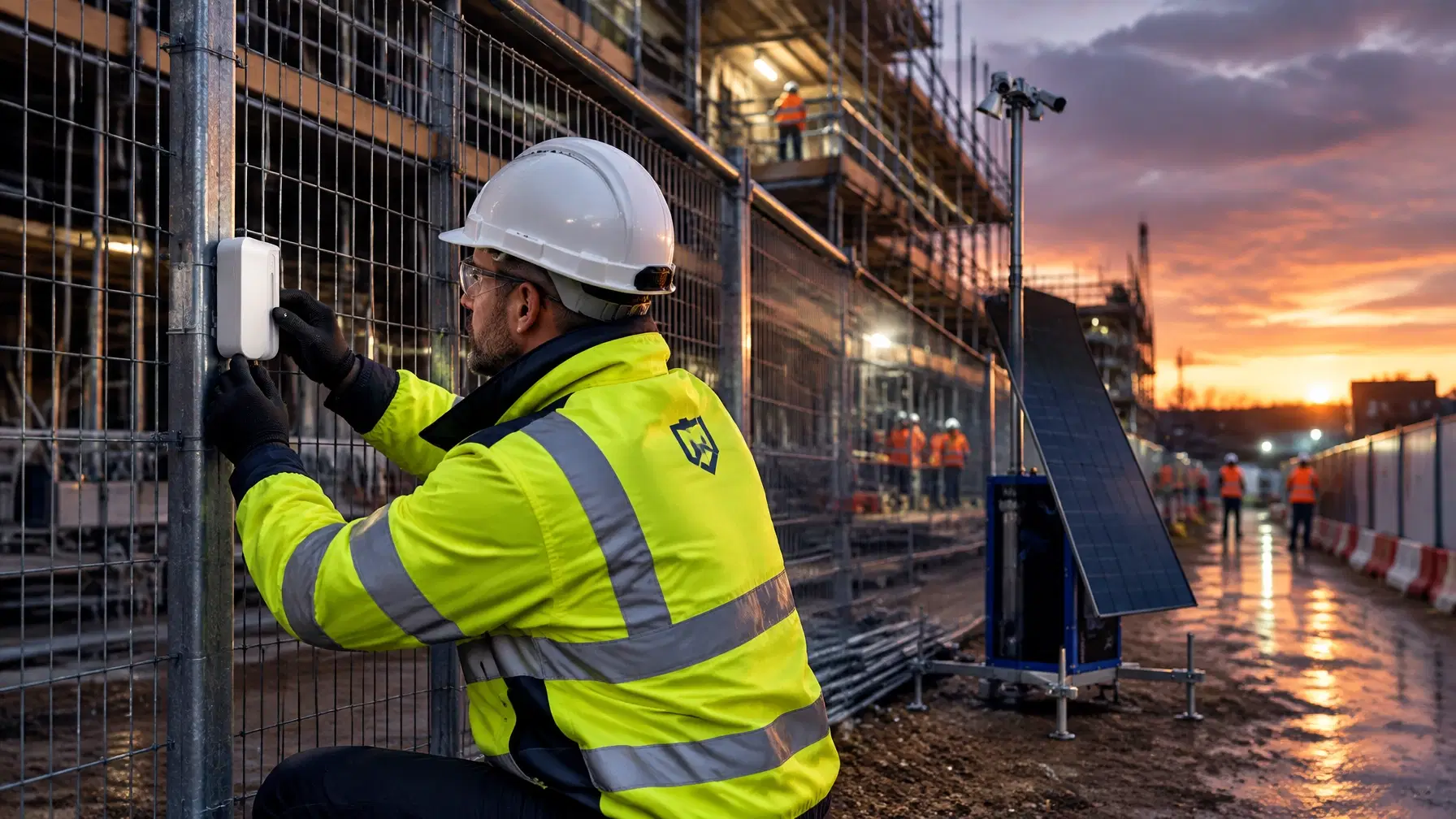
At 7:06 on Monday morning, the site manager walked the compound and found the scaffold two lifts higher than it had been on Friday.
The loading bay had moved.
The access gate had shifted six metres.
The old alarm panel was still in the same place, sitting neatly inside the new perimeter. The siren was pointing at yesterday’s work area. One detector was now looking at a stack of boards. Another was blocked by freshly installed netting.
The site had security.
It just no longer secured the site that actually existed.
That is the issue with many scaffolding security systems. They are designed as a one-off installation, then left behind while the project changes around them.
Your security design should climb the scaffold with your team.
Specify a redeployable kit, not a fixed installation
Scaffolding is not static. Neither is the risk around it.
Scaffold lifts go up. Compounds move. Brickwork closes openings. Loading bays are relocated. Aluminium tubes, boards and fittings are stored in a different place by Friday than they were on Monday.
A fixed security design quickly becomes yesterday’s plan.
For installers and integrators, the better approach is to specify rapid deployment security as a redeployable kit:
- 🔧 Detection that can be lifted and re-sited.
- 🔋 Battery powered alarm systems with no mains requirement.
- 📡 Wireless site alarms that can be commissioned again the same day.
- 🚨 A defined ARC response process.
- 📱 App access for authorised users working across a changing site.
Construction site theft costs the UK over £1 billion a year. Tool theft alone runs to around £100 million a year, with an average loss of about £610 per reported incident.
Plant theft exceeds 11,000 reported incidents a year, with under 15% recovered.
And the true cost of a site theft is typically three to five times the value of what was taken once delays, replacement costs and programme penalties are included.
Scaffolding tubes, boards and fittings remain a routine target. Leaving security fixed in the wrong place is an expensive way to create blind spots.
Design the outer layer to move with the boundary
The outer layer should provide early warning before somebody reaches the scaffold, compound or materials.
This is where Optex wireless perimeter detection earns its place.
Use:
- BXS-R (W) wireless outdoor curtain detection for narrow scaffold frontage and elevations.
- AX-200TFR battery-powered infrared beams across longer approach routes and open compounds.
- Redscan LiDAR where a precise detection field is needed around a particular access route, elevation or high-value zone.
Nothing to re-run.
Nothing to bury.
The sensors can be lifted and re-sited as the boundary moves. That is the point. You are not trying to force a permanent perimeter onto a temporary project.
The Optex range gives you the flexibility to revise the detection plan as the scaffold changes, rather than accepting the limitations of the original drawing.
Keep the visible deterrent flexible
A Wall2Wall security tower, available for hire or purchase, can cover the compound or gate elevation as a visible companion layer.
Keep it where it provides the most value.
That might be the vehicle gate this week, the plant compound next week, and the material storage area after the next site move.
It is useful visible protection. But it should support the redeployable alarm design, not replace it.
Bring the alarm and verification layer up the scaffold
The inner layers should be equally straightforward to move.
A practical VESTA arrangement includes:
- VESTA 068 hub with 4G connectivity and support for up to 50 wireless devices.
- VESTA 460 outdoor PIRCAM, sending visual verification images to the authorised user and the ARC.
- VESTA 011 keypad for controlled local arming and disarming.
- VESTA outdoor siren, delivering up to 104dB at 1 metre.
- VESTA 039 manual call point, installed as a clearly identified emergency activation device in a position that satisfies the site risk assessment.
All are battery powered. There is no mains requirement to hold the system in place.
That makes removal and reinstallation far less painful. It also means your team is not waiting for a temporary power supply to be installed before the alarm can go live.
The VESTA range is built around the practical reality of temporary and changing environments.

What changes as the scaffold climbs?
1. Frame erected
Start with the first accessible elevation and the routes a person could use to reach the structure.
The design needs to:
- Protect the base and initial access points.
- Establish the VESTA 068 hub in a secure but serviceable position.
- Cover the compound gate and material storage area.
- Confirm the ARC response process before the site is left unattended.
2. Lifts added
As the scaffold rises, move detection with it.
The VESTA 460 should be repositioned to maintain visual verification across the active lifts. Any wireless perimeter detection affected by the new footprint must be re-sited and tested.
Do not leave a detector covering the old elevation simply because it is still reporting healthy.
3. Brickwork and cladding
The risk profile changes again.
Openings close. Routes narrow. New loading bays appear. Plant and materials are often moved below the active elevation.
Review the detection field and ensure the alarm is protecting the current access route, not the route shown on the original method statement.
4. Netting and sheeting
Netting changes line of sight, wind loading and access patterns.
Check every detector for obstruction, masking and altered coverage. This is also the point where a manual call point can become difficult to reach if it was installed without future scaffold movements in mind.
The VESTA 039 must remain reachable, clearly signed and positioned in line with the site risk assessment, especially as escape routes change.
5. Struck and demobilised
When the scaffold comes down, the kit should come down with it.
Remove, inspect, relabel and recharge or replace batteries where required. Record the final event history. Then redeploy the kit to the next elevation, compound or project.
That is how temporary site security becomes a reusable operational asset rather than a disposable installation.
Control access without copying keys
Access is another part of redeployment that is often overlooked.
A Loxal key safe gives scaffold crews, subcontractors and out-of-hours callouts managed access without cutting or duplicating keys.
With IDACS cloud code management, you can issue temporary codes, manage users and review audit trails. The system supports permanent and temporary access, with Secured by Design and Sold Secure Silver credentials available across relevant products.

That matters when the gate moves, the subcontractor changes or an emergency callout happens at 2am. You can provide access without handing out a sensitive master key.
Use this redeployment and commissioning checklist
Before leaving the site, confirm:
- ✅ Every detector matches the current scaffold and compound layout.
- ✅ BXS-R (W), AX-200TFR and Redscan detection fields are clear and correctly aligned.
- ✅ The VESTA 068 hub has reliable 4G communication.
- ✅ VESTA 460 visual verification images reach the user and the ARC.
- ✅ The VESTA 011 keypad is accessible to authorised users.
- ✅ The outdoor siren is visible, secure and audible.
- ✅ The VESTA 039 manual call point is reachable, correctly signed and risk-assessment compliant.
- ✅ The Loxal key safe code permissions are current.
- ✅ SmartHomeSec app users can arm, disarm and see events.
- ✅ The ARC has the updated site layout, keyholder details and response instructions.
- ✅ A full alarm, tamper, fault and communication test is recorded.
When is a fixed installation still right?
A fixed installation can still be the correct answer.
If the building footprint, access routes and power infrastructure are stable for the duration of the project, a hardwired system may be appropriate. The same applies to permanent commercial premises, completed developments and sites where detection positions will not change.
But scaffolding is rarely that tidy.
For evolving construction sites, scaffold projects, vacant buildings and void property alarm systems, wireless redeployment usually gives the installer more control, less disruption and a faster route to live protection.
After more than 30 years in the industry, we know the best system is not always the one with the most equipment. It is the one that stays useful after the site changes.
A security system that cannot move with the job is already behind it.

At Wall2Wall Security, we help installers and integrators build multi-layered security around changing sites using wireless perimeter detection, battery powered alarm systems, professional monitoring services and defined ARC response.
If your next project has scaffold lifts, shifting compounds or temporary access routes, contact Wall2Wall Security and let’s work out what needs to move, when it needs to move and how quickly it can be live again.
Is your current scaffolding security design ready to climb with the job?
Meta description
Rapid deployment security for installers: specify redeployable scaffolding alarms, wireless perimeter detection and ARC response as your site changes.