








Meta description: Discover why fencing and stand-alone cameras fail against professional intruders: and how Optex and VESTA create a layered, rapid deployment security solution.
A fence can look secure and still offer almost no real protection.
A camera can record an intrusion perfectly and still fail to stop it.
That is the uncomfortable truth for installers and integrators protecting construction sites, scaffolding projects and vacant properties.
Professional intruders do not attack security systems randomly. They test them. They identify blind spots, weak gates, dead zones and predictable response gaps.
If your client’s protection depends on one barrier or one technology, it is not a security strategy. It is a single point of failure.
Stop treating a fence as the perimeter solution
Basic fencing has a role. It defines the boundary, discourages casual trespass and provides some physical delay.
But it does not detect a breach.
The RCMP Security Fencing Considerations Guide makes the point clearly: without detection equipment, the effective delay provided by a fence can be essentially zero.
That matters because a determined intruder can:
- ✂️ Cut through standard mesh.
- 🧗 Climb over or exploit nearby objects.
- 🚪 Target gates, hinges and weak locks.
- 🕳️ Use gaps beneath temporary fencing.
- 🌙 Choose periods when the site is empty.
Temporary fencing is especially vulnerable. Panels move. Ground conditions change. Gates are frequently opened. Vegetation creates cover.
A fence remains useful: but only as the first layer.

Cameras alone record the problem
Stand-alone cameras are valuable for verification, evidence and oversight.
They are not a complete perimeter detection system.
A camera may show you what happened after tools, materials or plant have already left the site. It may miss activity because of:
- Poor lighting.
- Blind spots.
- Weather or glare.
- Camera tampering.
- Obstructions and changing site layouts.
- No live alarm trigger or defined response.
Continuous video surveillance of a fence line is not automatically effective detection. If nobody is actively assessing the footage, the system remains reactive.
That is the difference between seeing an intrusion and responding to one.
A professional solution links detection, visual verification, audible deterrence and remote response. Each layer supports the next.
Build an “onion” of protection
The strongest temporary site security strategy works like an onion.
Not glamorous. Extremely effective.
Each layer creates another obstacle for the intruder: and another opportunity for your system to detect, assess and respond.
1. Deter with visible physical security
Start with well-installed fencing, secure gates, warning signage and clear sight lines.
Remove footholds and hiding places where possible. Keep the perimeter maintained. Make the site look controlled, occupied and difficult to approach unnoticed.
For higher-risk projects, consider internal zones around fuel, plant, tools and valuable materials. If the outer layer is breached, the inner layer still protects the priority assets.
2. Detect with wireless perimeter detection
This is where a passive boundary becomes an active security line.
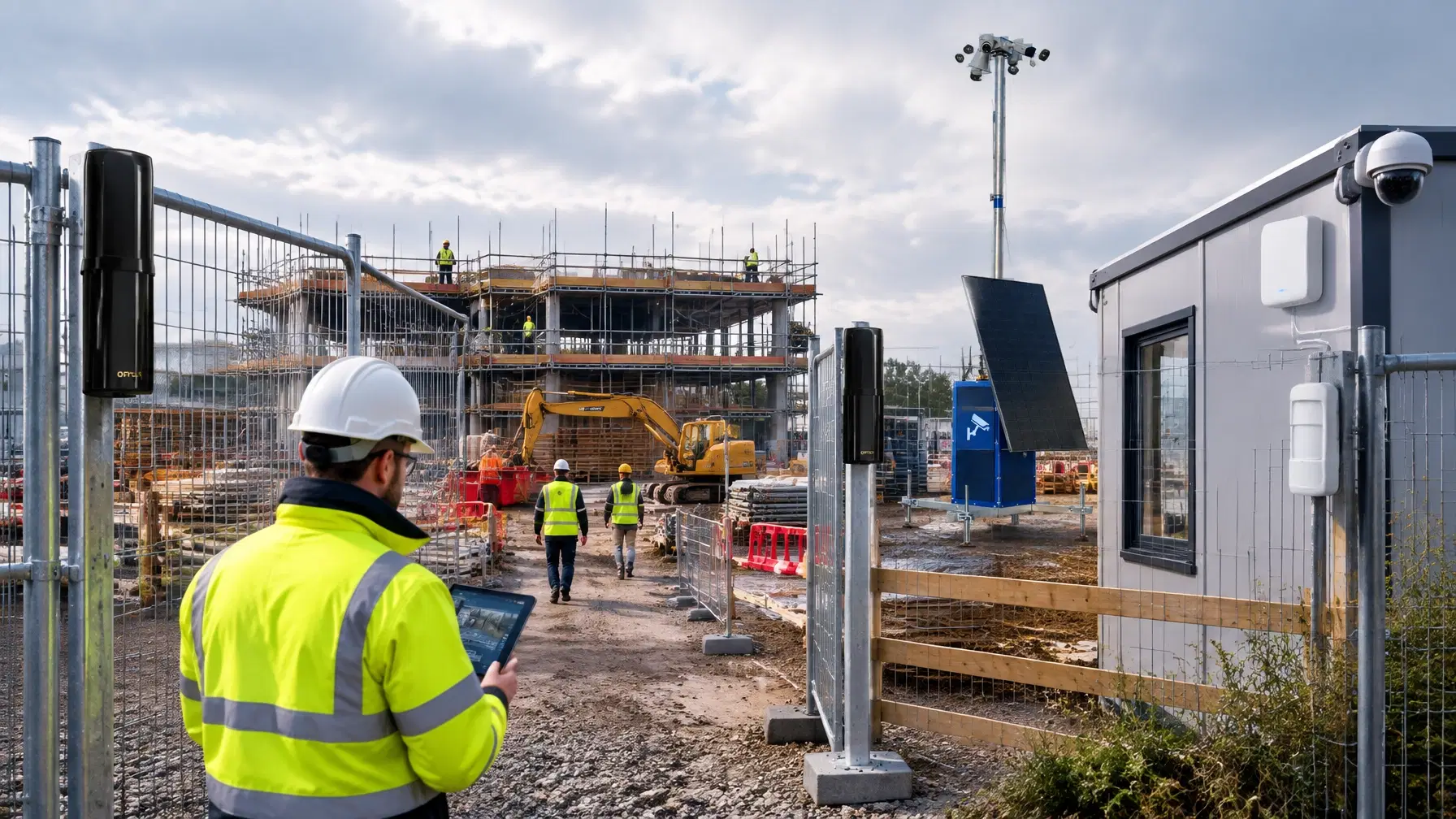
Optex wireless perimeter detection gives installers flexible options for changing environments where trenching cables is slow, expensive or impractical.
The range includes:
- AX-100TFR: a battery-powered outdoor infrared beam with 30m range, four-channel selection and triple tamper functions.
- AX-200TFR: a battery-powered outdoor infrared beam with 60m range, IP55 protection and triple tamper functions.
- BXS-R(W): a wireless outdoor curtain detector with detection up to 12m per side, anti-masking and independent detection settings.
These devices help protect approaches, gates, access routes and vulnerable sections of the boundary.
They are particularly suited to temporary site security, where the perimeter may need to move as construction progresses.
3. Verify with cameras and security towers
Detection should trigger assessment: not a flood of unverified alerts.
A camera or rapidly deployable security tower can provide the visual confirmation needed to identify people, vehicles and activity. This reduces uncertainty and helps professional monitoring services determine the correct response.
Wall2Wall Security towers support up to four camera mounts, solar power options and a secure steel cabinet. They can be operational in under an hour.
That gives you a visible deterrent and a practical verification layer without waiting for permanent infrastructure.

4. Alarm, communicate and respond
Detection is only useful when it leads to action.
A VESTA rapid deployment alarm system provides the control layer for wireless devices, alarm events and remote communications.
VESTA systems are available in Grade 2 and Grade 3 configurations. The battery-powered VESTA-068N supports up to 50 wireless zones, 4G communication and up to 1.4 years of battery autonomy. Its integrated 100dB siren provides an immediate local alert.
VESTA also integrates with outdoor detectors, PIRCAM devices, sirens and other site security equipment. The VESTA-400 transmitter can connect Optex sensors to the VESTA platform, with installation in less than five minutes.
That is rapid deployment security designed around the realities of temporary and evolving sites.

Design the system around the site: not the product catalogue
Every site has different risks. Your design should begin with a threat assessment, not a shopping list.
Ask:
- Where are the most likely approach routes?
- Which gates or fence sections are weakest?
- Is mains power available and reliable?
- What happens if the outer perimeter is breached?
- Which assets require a second layer of protection?
- Who receives the alarm and how quickly can they respond?
- How will the system change as the site develops?
A strong specification typically combines:
- 🧱 Physical fencing and controlled access.
- 📡 Optex wireless perimeter detection.
- 📷 Cameras or security towers for visual assessment.
- 🚨 VESTA alarms, sirens and event communications.
- 👁️ Professional monitoring services for remote response.
- 🔧 Regular testing, maintenance and battery supervision.
- 🎯 Inner protection for high-value equipment and materials.
This approach also gives you a more compelling proposition. You are not simply supplying a camera or fitting an alarm panel. You are delivering an integrated security architecture that can be redeployed, expanded and adapted.
The Wall2Wall advantage
With more than 30 years of industry experience, Wall2Wall Security understands the operational pressures installers and integrators face.
Your clients want protection quickly. They do not want weeks of cabling, excessive site disruption or a system that becomes obsolete when the project layout changes.
Our focus is flexible, wireless and rapidly deployable technology for construction sites, scaffolding, vacant properties and other changing environments.
Single-layer security is easy to specify.
Layered security is what professional protection looks like.
Ready to strengthen your next site design? Explore our Optex solutions, review the VESTA alarm range or contact Wall2Wall Security to discuss the project.