








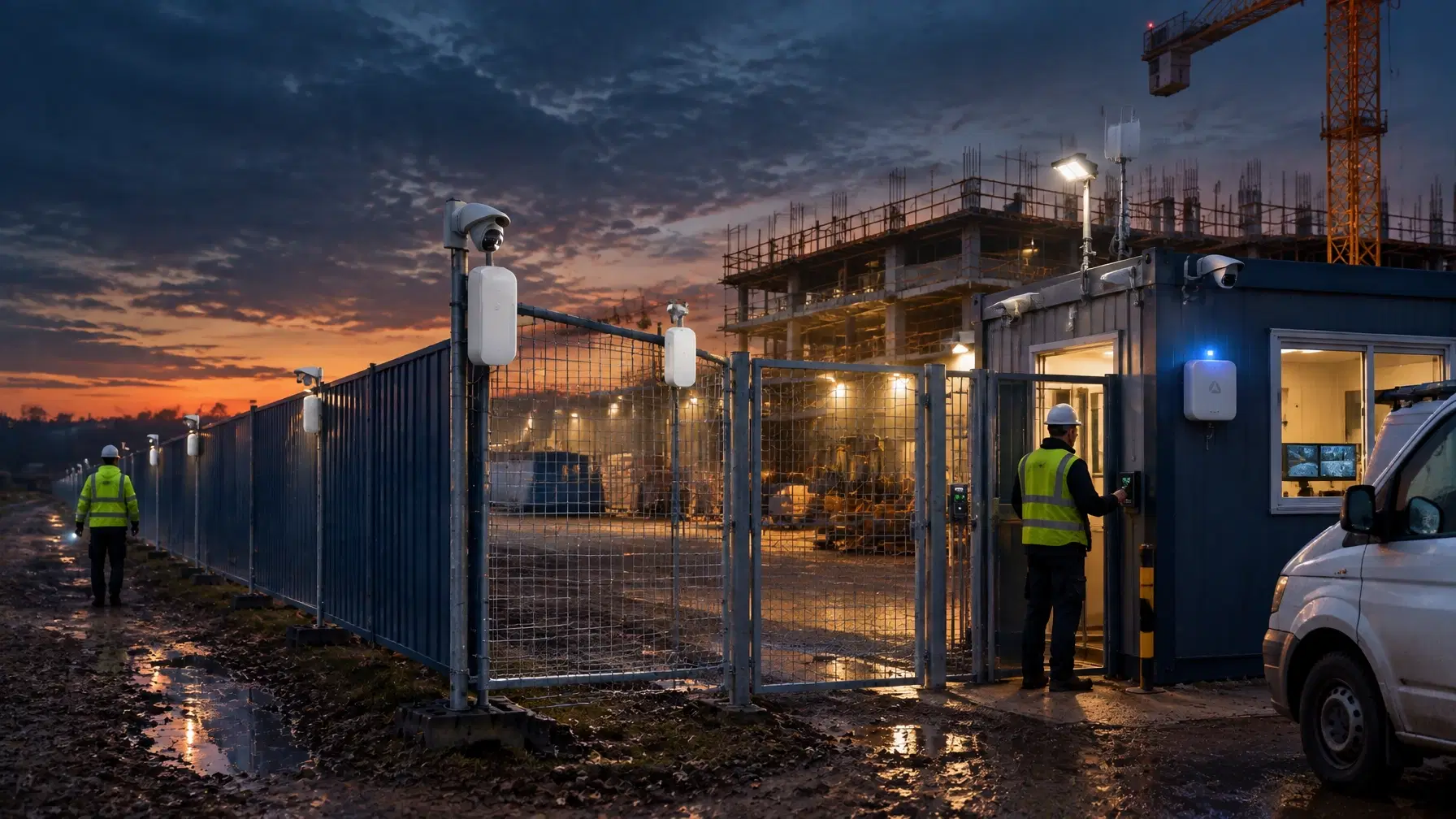
Meta description: Discover why fencing and stand-alone cameras fail against professional intruders, and how Optex wireless perimeter detection and VESTA alarms create a layered, rapid deployment defence.
A fence is not a security system.
A camera is not a security system.
And a siren that nobody responds to is, at best, an expensive noise-maker.
For professional installers and integrators, the real question is whether a site has enough independent layers to withstand a determined intruder.
Professional intruders look for gaps, test weak points and exploit predictable coverage or single points of failure.
That is why the traditional “fence plus camera” approach is increasingly out of date.
The smarter answer is an onion defence: multiple layers of protection designed to detect, delay, verify and respond before an intruder reaches the asset.
Stop Treating the Fence as the Finish Line
Temporary fencing is essential. It defines the boundary, controls access and creates a physical obstacle.
But it does not tell you when someone is cutting through it at 2am, identify a person climbing over it or stop a prepared intruder who has already studied the site.
A professional can exploit:
- Weak points around gates and corners.
- Gaps between hoarding and scaffolding.
- Poorly secured ground-to-scaffold transitions.
- Areas hidden from roads or neighbouring properties.
- Sections of fencing moved during construction activity.
A fence creates delay. It does not create awareness.
That distinction matters. The earlier you know an intrusion is taking place, the more options you have to verify the threat, activate deterrents and coordinate a response.
The US Department of Homeland Security describes perimeter intrusion detection sensors as tools used alongside physical barriers and access control to enhance the probability of detecting intruders. That is the critical point: alongside, not instead of.
Why Stand-Alone Cameras Are Not Enough
CCTV is valuable. It provides visual verification, evidence and situational awareness.
But a camera-only system is often reactive rather than preventative.
By the time a camera captures a person inside the site:
- The perimeter has already been breached.
- Valuable time has been lost.
- The intruder may already be at the plant, fuel or materials.
- Operators may be reviewing multiple feeds rather than receiving a prioritised alert.
- Poor lighting, weather, obstructions and blind spots can reduce visibility.
A camera records what happened, but it does not always detect the first attempt to enter.
This is particularly problematic on construction sites, where layouts evolve quickly. A camera positioned perfectly on Monday may be looking at the wrong access route by Friday.
The answer is not necessarily more cameras. It is better integration between detection, verification and response.
Build a Security Onion, Not a Single Barrier
The onion model is simple: create several concentric layers around the risk.
Each layer should perform a different job. If one layer is bypassed, the next one is ready.

Layer 1: Create a Physical Boundary
Start with the basics.
Use temporary fencing, hoarding, secure gates and vehicle barriers to define the site and make unauthorised access more difficult.
Then assess the boundary as an intruder would. Ask:
- Where can someone approach unseen?
- Which gates are used outside working hours?
- Could a vehicle breach the perimeter?
- Are ladders, skips or stored materials creating climbing aids?
- Will the boundary move as the project develops?
The physical layer should support the technology, not act as the complete solution.
Layer 2: Detect at the Perimeter
This is where wireless perimeter detection changes the game.
Instead of waiting for someone to reach a building, detect movement at the boundary, along vulnerable elevations or across open approaches.
Wall2Wall Security supplies Optex wireless outdoor detection devices that integrate with VESTA systems through compatible wireless transmission modules. In the onion model, Optex forms the outer ring of wireless perimeter detection. Depending on the site, installers can use:
- BXS-R (W) for narrow perimeter runs and scaffold edges.
- AX-200TFR for longer-range infrared beam coverage, with detection across distances up to 60 metres.
- Outdoor PIR and curtain-style detectors for building lines, windows and access routes.
These devices create an invisible outer-perimeter detection layer around the site.
The advantage is flexibility. Sensors can be positioned where the risk actually exists and moved as the site changes.
No trenching. No long cable runs. No waiting for permanent infrastructure.
That is rapid deployment security built for temporary site security.
Layer 3: Verify and Deter
Detection without verification can create nuisance alarms. Verification without a response plan creates frustration.
This layer connects the two.
Pair perimeter sensors with visual verification, lighting, audio warnings or security towers where appropriate. When an alarm is triggered, the system should help answer three questions quickly:
- What happened?
- Where did it happen?
- What action should follow?
A visible warning, audible intervention or rapid camera verification can make the difference between an attempted intrusion and a completed theft.
It also helps professional monitoring services and the supporting ARC (Alarm Receiving Centre) prioritise genuine events instead of treating every activation the same way.
Layer 4: Protect the Inner Zone
If an intruder reaches the site interior, the protection should not stop.
Secure high-value areas separately:
- Plant and machinery.
- Fuel stores.
- Copper and valuable materials.
- Tool containers.
- Internal plant rooms.
- Vacant buildings awaiting occupation.
This is where VESTA rapid deployment alarms provide a practical inner layer.
VESTA covers the inner rings with devices such as the 068 hub, 460 outdoor PIRCAM, 011 keypad and 039 manual call point, giving installers flexible protection for site buildings, access points and high-value internal zones.
VESTA wireless control panels and detectors can be installed without relying on permanent mains power or complex cabling. The platform supports up to 50 wireless zones, a wireless range of up to 2 kilometres in suitable conditions, and EN50131 Grade 2 system certification.

For installers, that means one flexible system can cover multiple risk zones rather than forcing every asset into the same alarm group.
Put a Response Behind the Technology
This is the layer that is often forgotten.
An alarm is only useful if somebody receives it, understands it and acts on it.
Professional monitoring services provide the customer-facing support behind the equipment, with events handled through an ARC (Alarm Receiving Centre) when an agreed response procedure is in place. When an Optex outer-perimeter detector or a VESTA inner-layer device activates, the event can be assessed and escalated quickly.
A robust workflow should define:
- Alarm verification.
- Keyholder notification.
- Audio intervention where available.
- Guard or emergency service escalation.
- Event logging and follow-up.
- Battery and device health checks.
Technology buys time. A response plan makes that time count.
Why Wireless Is the Right Choice for Changing Sites
Construction sites, scaffolding projects and vacant properties are not static environments.
The perimeter moves. Access points change. Power may be unreliable. Risk increases around deliveries, fit-out stages and equipment storage.
Hardwired systems can be effective in permanent buildings, but they are often slow and disruptive in temporary environments. Wireless equipment allows your team to deploy protection quickly, reposition devices and scale coverage as the project develops.
That is the practical advantage of combining Optex wireless perimeter detection with VESTA rapid deployment alarms.
You get early warning on the outer ring, protected inner layers around assets and access points, and the flexibility to adapt without starting the installation from scratch.
The Wall2Wall Security Advantage
Wall2Wall Security has more than 30 years of industry experience supporting professional installers and integrators.
We understand the pressure behind every deployment:
- The client wants protection immediately.
- The site is changing by the week.
- Mains power may not be available.
- Equipment must be reliable in harsh conditions.
- False alarms must be controlled.
- Your installation time directly affects margin.
Our approach is straightforward: design the layers around the site, not the other way around.
The result is flexible, wireless and rapidly deployable protection that keeps pace with the project.
Ready to Strengthen the Perimeter?
If your current site protection relies on a fence, a stand-alone camera or an unmonitored siren, it may have a gap waiting to be found.
Build the onion instead:
- 🛡️ Physical barriers to delay access.
- 📡 Optex wireless perimeter detection for outer-ring early warning.
- 📸 Visual verification and deterrence.
- 🚨 VESTA rapid deployment alarms for inner layers and asset zones.
- 👁️ Professional monitoring services with ARC (Alarm Receiving Centre) support for coordinated response.
Explore our Optex perimeter detection solutions and VESTA wireless alarm systems, or contact Wall2Wall Security to discuss your next temporary site security project.
What is the weakest layer on your client’s perimeter right now? Send us a message and let’s level it up.