








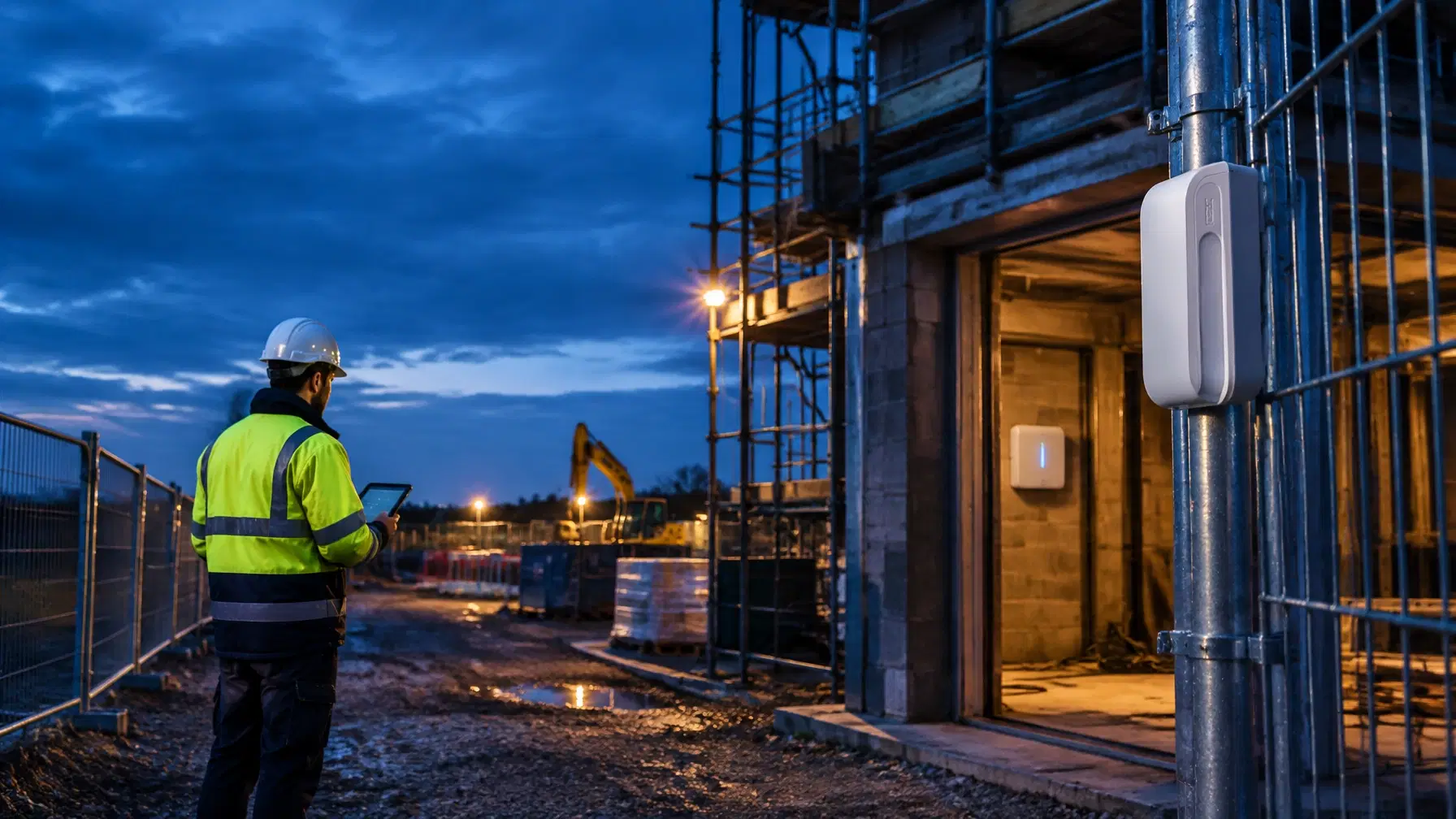
Meta description: Your camera recorded the theft, but it never had a chance to prevent it. See how wireless perimeter detection and VESTA alarms add the layers CCTV cannot.
I was on a site recently where the perimeter looked secure from the road.
New fencing. Locked gates. Cameras on the main entrance.
Then we walked the boundary.
There was a blind spot behind stored materials, a gap between the hoarding and scaffolding, and no alarm if somebody crossed the fence line.
That is not the same as stopping it.
For professional installers and integrators, the question is simple: is the perimeter designed to detect an intruder early, or simply document the failure afterwards?
Follow the intrusion timeline
Here is how a single-layer system unravels against an intruder who studies the site, tests the response and takes the path of least resistance.
1. 22:47, The approach
The intruder studies the site from outside.
They identify dark areas, quiet access routes and the section of fencing furthest from public view.
A fence creates a physical boundary. It does not report somebody approaching it.
2. 22:51, The first breach
The fence is climbed, cut or bypassed through an open section.
If there is no perimeter detection, the alarm remains silent.
A stand-alone camera may capture the event, but only if the person enters its field of view, lighting is adequate and somebody is actively reviewing the footage.
3. 22:56. The asset is reached
By the time an internal PIR, door contact or motion camera activates, the intruder may already be beside the plant, fuel, copper or tools.
The response window has disappeared.
4. 23:10. The real cost begins
The loss is not limited to the stolen equipment.
Your client may also face:
- 🚧 Project delays and missed handover dates.
- 🔧 Replacement hire and emergency labour costs.
- 🧾 Insurance claims and excess payments.
- 🔐 Damaged doors, fencing and temporary works.
- 📉 Loss of confidence in the installation and installer.
The theft value is often the smallest line on the final invoice.
Stop asking whether the camera works
CCTV remains valuable. It provides verification, evidence and situational awareness.
But cameras should not be expected to do every job.
A camera is excellent at answering: “What happened here?”
A perimeter detector is designed to answer: “Has somebody crossed the boundary?”
That distinction matters.
The National Protective Security Authority guidance on perimeter intrusion detection systems makes the point clearly: select detection around the site, its environment and your response plan, and pair it with a physical barrier.
In other words, the fence is one layer. It is not the whole onion.
Build the onion from the outside in
A resilient temporary site security design should create several opportunities to detect, deter and respond.
Layer one: delay the intrusion
Use fencing, hoarding, secure gates and vehicle barriers to make access more difficult.
Then walk the boundary as an intruder would.
Look for:
- Blind corners and concealed approaches.
- Gaps around gates and scaffolding.
- Stored materials that create climbing aids.
- Sections likely to move during construction.
The physical barrier buys time. It does not create awareness.
Layer two: detect at the perimeter
This is where wireless perimeter detection earns its place.
Wall2Wall Security supplies Optex perimeter detection solutions for installers protecting construction sites, scaffolding projects and vacant properties.
Depending on the layout, an installer can specify:
- BXS-R (W) wireless curtain detection with coverage up to 12 metres per side.
- AX-200TFR outdoor wireless infrared beams covering distances up to 60 metres.
- Battery-powered outdoor detection positioned along vulnerable boundaries and access routes.
These devices provide early warning before an intruder reaches the building or high-value assets.
The wireless advantage is straightforward: less infrastructure, faster installation and easier repositioning as the site evolves.

Layer three: verify and deter
The next question is simple: what happens when the perimeter activates?
Combine detection with visual verification, lighting, audio warnings or a security tower where appropriate.
Your response team should be able to identify:
- What has activated.
- Where the event occurred.
- What action is required.
This is where professional monitoring services and an ARC add value. The event is not left sitting in an app waiting for somebody to notice it.
Layer four: protect the inner zones
Assume the perimeter may eventually be breached.
Protect the assets that matter most with a second and third opportunity to detect the intruder.
The VESTA rapid deployment alarm range provides flexible wireless protection for internal areas, plant rooms, containers, access points and unfinished buildings.
The VESTA-068N supports 50 wireless zones, 4G communication, a built-in 100dB siren and battery autonomy of up to 1.4 years. Compatible VESTA radio devices communicate over distances of up to 2 kilometres in open field conditions.
The VESTA-460 adds HD images, a 10-metre / 90-degree PIR field and IP65 protection.
That is a genuine inner layer, not one alarm point at the main entrance.

Use this installer design checklist
Before handing over the system, ask:
- 🛡️ Is there a physical barrier supporting the detection system?
- 📡 Does the outer layer detect movement before the building is reached?
- 👁️ Can an operator verify the event quickly?
- 🔋 Have battery levels, tamper alerts and signal strength been checked?
- 📞 Is there a clear ARC and keyholder escalation procedure?
If the answer to any of these is no, the site may still have a gap.

The practical answer for changing sites
Construction sites and vacant properties rarely stay still.
The boundary moves. Scaffolding rises. Materials arrive. Access routes change. Permanent power may not yet exist.
That is why rapid deployment security works best when it is flexible by design.
Optex provides the outer warning layer. VESTA provides the alarm intelligence and inner protection. Professional monitoring services and an ARC support the response.
Wall2Wall Security has more than 30 years of industry experience helping installers and integrators deliver practical, wireless protection in difficult environments.
Do not sell your client a fence and hope for the best. Build the onion.
For advice on your next temporary site security project, explore Optex, review VESTA rapid deployment alarms, or contact Wall2Wall Security.
What is the weakest layer on your client’s perimeter right now?