








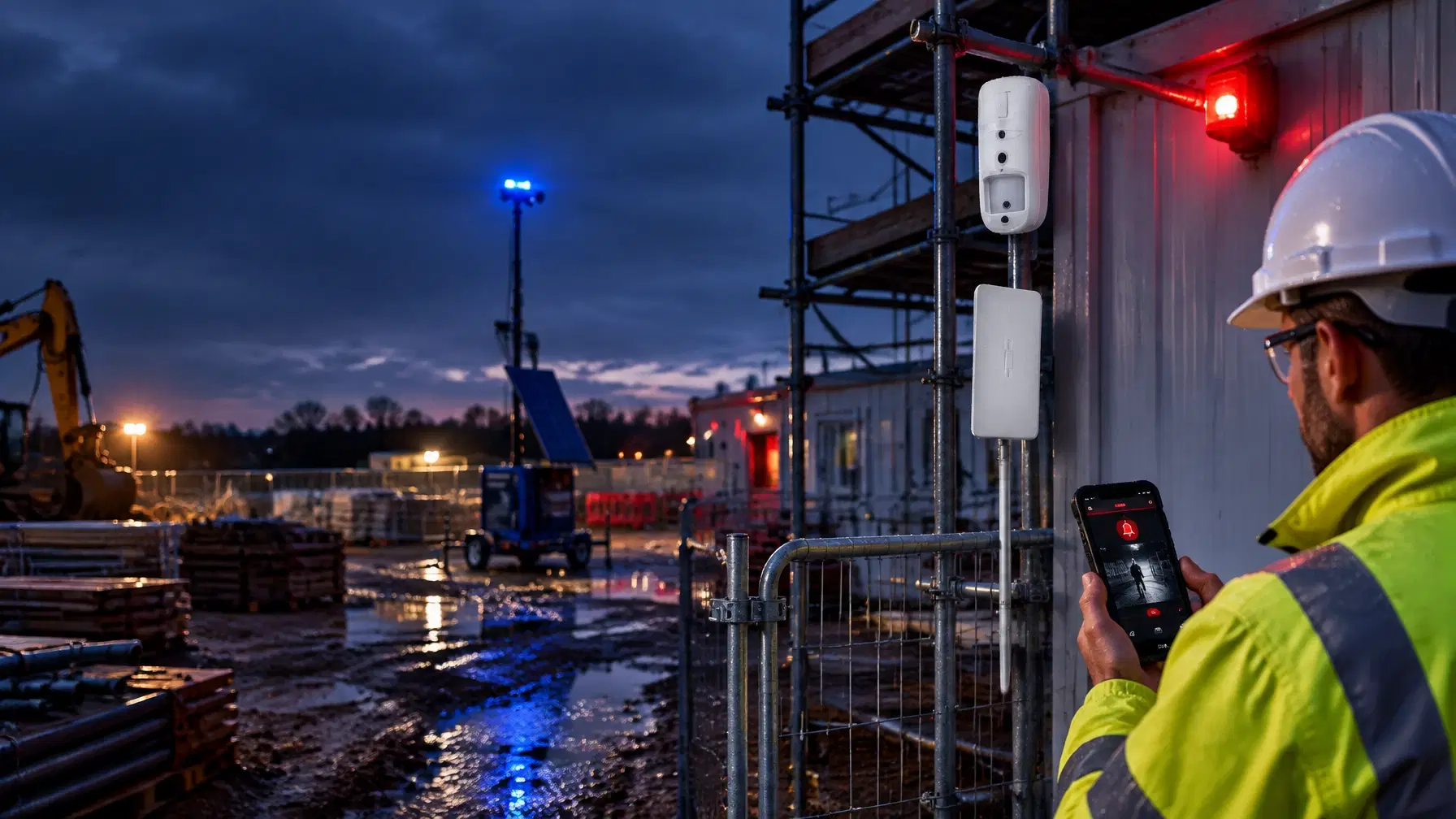
Meta description: Learn how to design an ARC response for temporary site security, using Optex perimeter detection, VESTA visual verification, manual call points and clear escalation procedures.
An alarm is not the response.
It is the trigger.
If nobody knows what happens next, even strong temporary site security becomes expensive noise.
For professional installers and integrators, the job is to define how the ARC (Alarm Receiving Centre) filters, verifies, prioritises and escalates events, while keeping access clear for responders.
With more than 30 years of industry experience, Wall2Wall Security takes a straightforward view: handover is half the job.
Start with the Alarm Journey, Not Just the Hardware
Temporary sites change constantly.
Fencing moves. Access changes. Scaffolding rises. Risks shift.
Your alarm journey should answer five questions:
- 📡 What detects the event?
- 📍 Where exactly has it happened?
- 👁️ How is the alarm verified?
- 📞 Who is contacted first?
- 🚨 When does the response escalate?
That is the difference between rapid deployment security and disconnected hardware.
Build the Layers Before You Build the Response
Strong temporary site security starts outside and works in.
Outer layer: detect the approach
Use Optex wireless perimeter detection around fence lines, gates, scaffold edges and open approaches.
Wireless curtain detectors, PIR devices or active infrared beams give early warning before an intruder reaches buildings, plant or stored materials. They also keep perimeter security fast to install and easy to move.
Explore the Optex perimeter detection range.
Inner layers: verify and protect
VESTA rapid deployment alarms provide the next layers.
The VESTA 068 hub supports up to 50 wireless zones, 4G communication and up to 1.4 years of battery autonomy. It links wireless perimeter detection to internal protection, verification and alerts without fixed infrastructure.
Use:
- VESTA 460 outdoor PIRCAM for visual verification around approaches, scaffold lines and vulnerable elevations.
- VESTA 011 keypad at controlled entry points.
- VESTA outdoor sirens for immediate audible deterrence, with models providing 104dB at 1 metre.
- Internal PIRs and door contacts around welfare units, containers, plant rooms and vacant buildings.
- Security towers for wider site visibility, elevated camera coverage and visible deterrence.

This multi-layered security design matters for scaffolding security systems. Scaffolding creates a direct route to upper floors, windows and roof spaces, so ground-level detection alone is not enough.
Read Wall2Wall’s guide to scaffolding security mistakes and how to fix them.
Define What the ARC Actually Receives
An ARC cannot respond intelligently to a vague “alarm activation”.
For every site, the ARC record should include:
- Site name, address and access details.
- Alarm type and device or zone reference.
- Event source: perimeter, internal, PIRCAM, tamper, technical or manual call point.
- Images from the VESTA 460, where available.
- Keyholder details and Loxal key safe access instructions.
Set emergency and guard escalation rules in advance.
Filter False Alarms Without Filtering Out the Threat
Temporary sites create noise.
Wind. Wildlife. Dust. Moving materials. Changing access routes.
If every activation gets the same response, you get wasted call-outs.
The answer is prioritised alarm filtering.
A practical hierarchy could be:
- Highest priority: VESTA 039 manual call point activation, verified visual intrusion, multiple sequential activations or confirmed fire indicators.
- High priority: Perimeter activation followed by an internal VESTA event.
- Standard priority: Single outdoor detector activation requiring visual or audio verification.
- Technical priority: Low battery, loss of supervision, tamper or communication failure.
- Planned activity: Authorised access, scheduled testing or site works.
Filtering must never compromise life safety. If a manual call point is activated, the agreed fire procedure applies.
PAS 9970 principles help define zones, verification, testing and responsibilities. Always confirm project requirements and the fire strategy with the responsible person.
Create the Escalation Matrix Before Handover
Do not ask the ARC to improvise at 2am.
Create a written escalation matrix during design.
For each alarm category, specify:
- Verification: Check images, linked activations and audio.
- Keyholder notification: Call primary, then secondary.
- Audio intervention: Issue a clear warning where supported.
- Guard escalation: Send a trained responder if needed.
- Emergency service escalation: Follow the agreed verified procedure.
- Follow-up: Record outcome, reset status and action taken.
The escalation matrix should also define what happens when nobody answers.
No response is not the same as no threat.
Make Access Part of the Security Design
A responder who cannot enter the site cannot resolve the incident.
Treat the Loxal key safe as part of the response design. Install it at a controlled location and give the ARC current access instructions.
The response plan should state:
- Who is authorised to access the key safe.
- Which gate or entrance the responder should use.
- Where the site plan is located.
- Which areas are safe to enter.
- Which areas require emergency service attendance.
- How access codes are changed when contractors or keyholders change.
Explore Loxal key safe solutions for controlled, auditable site access.

Test the Procedure, Not Just the Devices
A commissioning test should go beyond “the siren sounds”.
Test the complete journey:
- Activate an Optex perimeter detector.
- Trigger the VESTA 460 and confirm images reach the ARC.
- Test the VESTA 039 manual call point.
- Confirm the ARC receives the correct site, zone and alarm type.
- Check the VESTA 011 keypad process and keyholder calls.
- Test the Loxal access process.
- Check battery, supervision, radio and 4G status.
For the VESTA 039 manual call point, position call points on escape routes and near final exits and welfare units. Keep them visible and undamaged. Anyone discovering a fire must be able to raise the alarm fast.

Keep the Site Healthy After Handover
A temporary security system is only reliable if devices stay healthy.
Schedule regular checks through the SmartHomeSec app and the ARC process:
- Review low-battery warnings.
- Confirm periodic supervision signals.
- Check radio and 4G communication.
- Rebrief the ARC whenever contacts or procedures change.
Use void property alarm systems that match the property’s risk and insurance conditions. Battery powered alarm systems are often essential where utilities are isolated, but the final specification should still follow the insurer’s wording and the site risk assessment.

Design the Response Before the Alarm Sounds
The best ARC response is not created during an incident.
It is designed during survey, documented at commissioning and tested before handover.
For your next temporary site security project, combine:
- 🛡️ Optex wireless perimeter detection.
- 📸 VESTA 460 visual verification.
- 🔴 VESTA 039 manual call points in the right locations.
- 🔐 Loxal key safe access for authorised responders.
- 🗼 Construction site security towers where wider coverage is needed.
- 📞 A prioritised ARC escalation matrix.
That is how you move from “the alarm went off” to “the right person is taking the right action”.
Explore VESTA wireless alarm systems or contact Wall2Wall Security to discuss your next temporary site security, construction, scaffolding security systems or void property alarm systems deployment.
What happens after your client’s alarm sounds? If the answer is not documented, tested and accessible to the ARC, it is time to level up the response.