








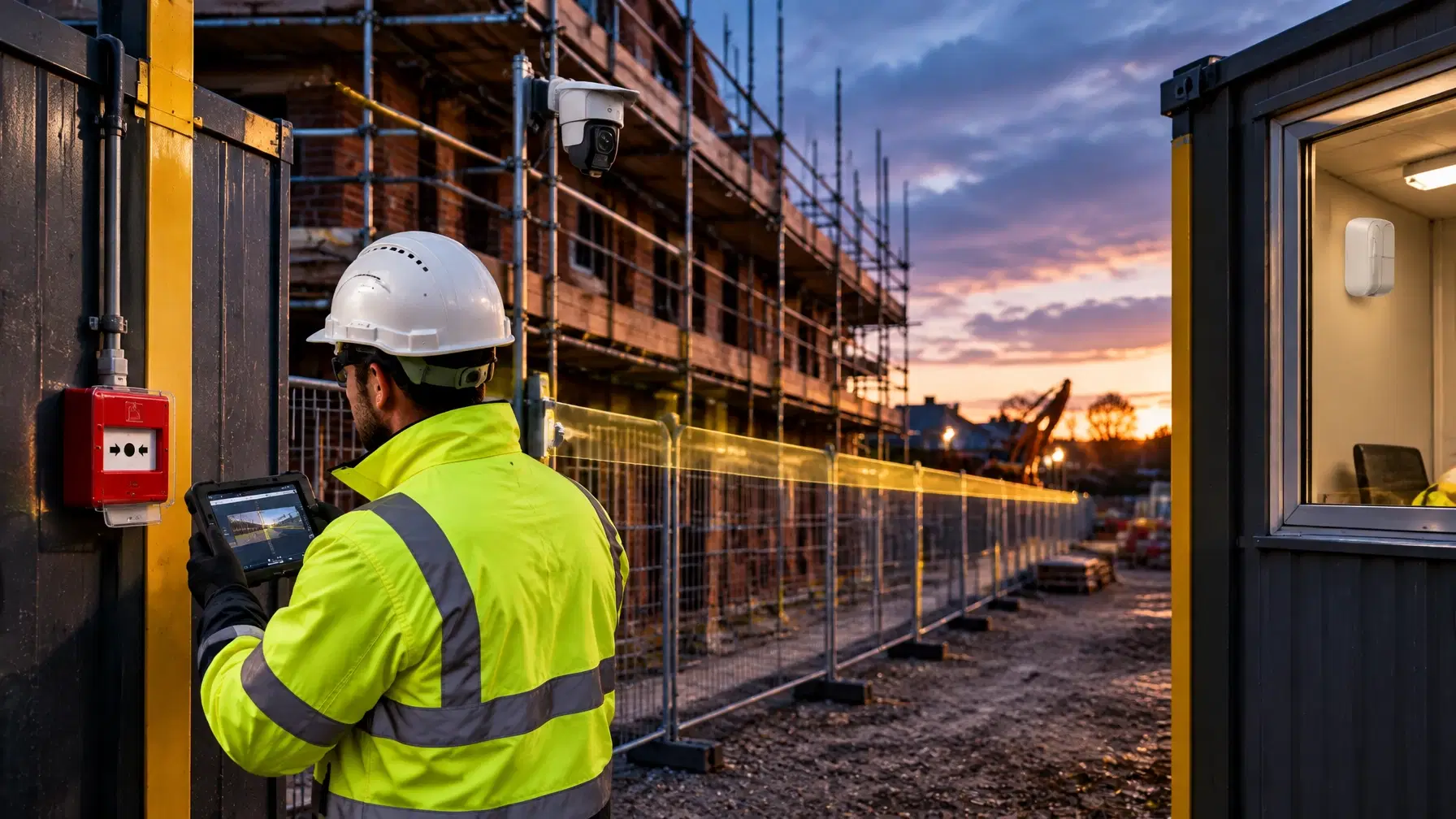
A manual call point is not a smoke detector.
That distinction sounds obvious.
On temporary and changing sites, it is also one of the most expensive details to get wrong.
If your client expects PAS 9970-aligned protection for construction plant, machinery or valuable assets, you need to understand exactly what each device does, where it belongs and how the alarm reaches the ARC (Alarm Receiving Centre).
The answer is not one device.
It is a multi-layered security strategy built around risk, site layout and response.
Understand What PAS 9970 Is Asking You to Achieve
PAS 9970 provides a structured approach to remotely monitored alarm systems used for construction sites, plant, machinery and asset protection.
It is particularly relevant to:
- 🏗️ Construction sites and evolving developments.
- 🚧 Hire and rental sites with valuable plant left overnight.
- 🛠️ Temporary compounds, storage areas and welfare units.
- 🏚️ Void properties awaiting refurbishment, sale or occupation.
- 🪜 Scaffolding projects where access routes change throughout the job.
The key principle is straightforward:
Your system must continue to provide meaningful protection as the site changes.
That means documenting:
- What risks are present.
- Which devices detect each risk.
- How alarms are communicated remotely.
- How events are verified.
- Who responds after an activation.
- How equipment is tested, maintained and repositioned.
PAS 9970 is not a reason to install one generic alarm package and walk away.
It is a reason to design a system that still works when fencing moves, scaffolding rises, contractors change and valuable equipment is left unattended.
Stop Confusing Manual Call Points with Smoke Detection
This is the central distinction.
A manual call point requires a person
A manual call point is activated by someone who sees, smells or otherwise identifies an emergency.
It gives people on site a fast way to raise the alarm.
The Vesta 039 is a manual call point.
It is designed to provide a deliberate, human-initiated alarm from an accessible location. It is not an automatic smoke detector. It does not continuously sample the air for smoke. It does not replace automatic fire detection.
Use it where people are likely to be present and need to raise an alarm quickly, such as:
- Site entrances and exits.
- Welfare cabins and offices.
- Temporary accommodation.
- Escape routes.
- Plant rooms and high-risk work areas.
- Key access points and muster-related locations.
It should be clearly visible, accessible and protected from accidental damage without making activation difficult.
Automatic smoke detection works without a person
Automatic smoke detection identifies smoke conditions without anyone needing to be present.
That matters after the site closes.
A fire can start in a plant room, welfare cabin, electrical area or enclosed construction zone long before a worker returns. A manual call point cannot detect that event on its own.
Automatic smoke or heat detection may be required where your risk assessment identifies:
- 🔥 High fire loads or ignition risks.
- 🔥 Plant rooms, generators or temporary electrical areas.
- 🔥 Welfare cabins, kitchens or sleeping risks.
- 🔥 Fuel, gas cylinder or flammable-material storage.
- 🔥 Enclosed areas that may remain unattended.
- 🔥 High-value plant or machinery requiring early warning.
The correct detector type depends on the environment. Dust, steam, fumes and temperature changes can all affect automatic detection and nuisance-alarm performance.
Do not specify automatic smoke detection by assumption. Specify it through the site risk assessment and fire strategy.

Why the Mistake Becomes Expensive
Installing only manual call points creates a serious overnight blind spot.
Installing only automatic smoke detection creates a different problem. People may not have an obvious, immediate way to raise the alarm when they discover an incident.
The devices solve different problems.
| Requirement | Manual call point | Automatic smoke detection |
|---|---|---|
| How it detects an event | Human activation | Automatic sensing |
| Main purpose | Raise an alarm quickly when an emergency is discovered | Detect smoke without relying on someone being present |
| Best use | Exits, escape routes, welfare areas and occupied work zones | Unoccupied areas, plant rooms, high-risk zones and enclosed spaces |
| What it does not do | Detect smoke independently | Replace accessible manual alarm activation |
| Role in a wider system | Human-initiated alarm layer | Unattended detection layer |
The practical answer is not “manual or automatic”.
It is manual and automatic, where the risk demands both.
Build the System Around the Vesta 068 Hub
For a rapidly changing site, the alarm architecture must be as flexible as the site itself.
The Vesta 068 hub provides the central point for the system, with:
- 📡 4G communication for sites without dependable fixed connectivity.
- 🔋 Battery-powered operation for temporary and off-grid environments.
- 🔗 Capacity for up to 50 wireless devices.
- 📲 Wireless integration with detection, alarm and verification devices.
That gives installers a practical foundation for rapid deployment security.
You can deploy the hub quickly.
You can add devices as the project develops.
You can reposition protection without returning to the drawing board for extensive cabling.
Pair the hub with Vesta 460 visual verification so alarm events can send images to the ARC. This allows professional monitoring services to assess what is happening before following the agreed escalation process.
That is the difference between receiving an alarm signal and receiving useful information.
The ARC can identify whether an activation appears to show:
- A genuine intruder.
- Unauthorised access near a scaffold line.
- A site worker or contractor.
- An environmental trigger.
- A developing incident requiring escalation.
For more detail, read our guide to what happens after the alarm sounds.
Protect the Outer Ring with Optex
The alarm hub and internal devices are only part of the design.
Start at the boundary.
Optex wireless perimeter detection can create an outer detection ring around fencing, hoarding, building elevations and access routes.
Use the right device for the geometry of the site:
- BXS-R (W): Suitable for narrow perimeter coverage, building faces, scaffold edges and vulnerable approaches.
- AX-200TFR: Suitable for longer-range outdoor beam protection across wider access routes and open approaches.
This layered design gives the site earlier warning.
It can detect activity before an intruder reaches a building, plant compound or scaffold access point.
That is particularly important for scaffolding security systems. The risk does not stay at ground level. As the scaffold moves, so should the protection.
Reposition detectors as:
- Scaffold lifts are added.
- Access ladders move.
- Hoarding lines change.
- Temporary gates are relocated.
- Work zones open or close.
- Plant storage areas change.
Read our guide to scaffolding security mistakes and how to fix them.

Do Not Forget Access and Asset Protection
Void properties create a different operational challenge.
There may be no permanent staff on site. Keyholders may change. Utilities may be isolated. Emergency responders still need a controlled way in.
A Loxal key safe belongs on the access side of the design.
It can provide authorised responders with controlled access when the ARC escalates an event. Record its location, access process and authorised users in the handover information.
A key safe is not an equipment tracker.
For plant, tools and valuable equipment, use Wall2Wall Asset Trackers as a separate protection layer. Physical access control and equipment tracking solve different problems and should not be treated as interchangeable.
You can also consider construction site security towers where elevated camera coverage, visible deterrence or wider site visibility is required.
For void property considerations, see our void property alarm systems guide.
Use This PAS 9970 Handover Checklist
Installers can lift this checklist directly into a project handover pack.
Site and risk assessment
- ☐ Site address, project details and responsible person recorded.
- ☐ Construction phase and expected site changes documented.
- ☐ Plant, machinery, fuel, storage and high-risk areas identified.
- ☐ Unoccupied periods and overnight risks recorded.
- ☐ Fire strategy and relevant project requirements confirmed.
Manual call points
- ☐ Vesta 039 devices are identified correctly as manual call points.
- ☐ Locations are visible, accessible and protected from site damage.
- ☐ Devices are positioned near exits, escape routes and agreed high-risk areas.
- ☐ Travel distances and mounting positions have been reviewed for the actual layout.
- ☐ Activation, reset and ARC procedures have been tested.
Automatic detection
- ☐ Automatic smoke or heat detection has been specified where the risk assessment requires it.
- ☐ Detector type is suitable for dust, fumes, steam and temperature conditions.
- ☐ Plant rooms, welfare areas, enclosed zones and high-risk storage have been reviewed.
- ☐ Nuisance-alarm risks have been considered.
- ☐ Detector locations are shown on the site plan.
Communications and verification
- ☐ Vesta 068 hub has 4G communication and suitable battery status.
- ☐ Wireless devices are enrolled and labelled by location.
- ☐ Vesta 460 images reach the ARC for visual verification.
- ☐ Optex BXS-R (W) and AX-200TFR coverage has been tested.
- ☐ ARC escalation contacts and response instructions are current.
- ☐ The Loxal key safe location and access procedure are documented.
Ongoing maintenance
- ☐ Battery and supervision checks are scheduled.
- ☐ Changes to fencing, scaffolding and access routes trigger a security review.
- ☐ New contractors and keyholders are added or removed promptly.
- ☐ Alarm activations, faults and maintenance actions are recorded.
- ☐ The full alarm journey has been retested after significant site changes.
Get the Distinction Right. Then Build the Layers.
A manual call point tells the system that a person has discovered an emergency.
Automatic smoke detection identifies a developing fire without waiting for a person.
Neither device is a universal substitute for the other.
The strongest temporary site security design combines both where required, then adds:
- Wireless perimeter detection.
- Vesta 068 central control.
- Vesta 460 visual verification.
- ARC response after the alarm.
- Controlled access through a Loxal key safe.
- Wall2Wall Asset Trackers for valuable equipment.
- Construction site security towers where wider visibility is needed.
That is how you move beyond a basic alarm installation and deliver a system that keeps pace with the job.
Wall2Wall Security has more than 30 years of experience supporting installers and integrators with flexible, wireless and rapidly deployable protection.
Need to review a PAS 9970 requirement, scaffolding project or hire-site deployment?
Explore VESTA, Optex and Loxal, or contact the Wall2Wall team.
Are your clients currently treating manual call points and automatic smoke detection as interchangeable? Share the challenge with your team, or send us a message to discuss the right deployment.