








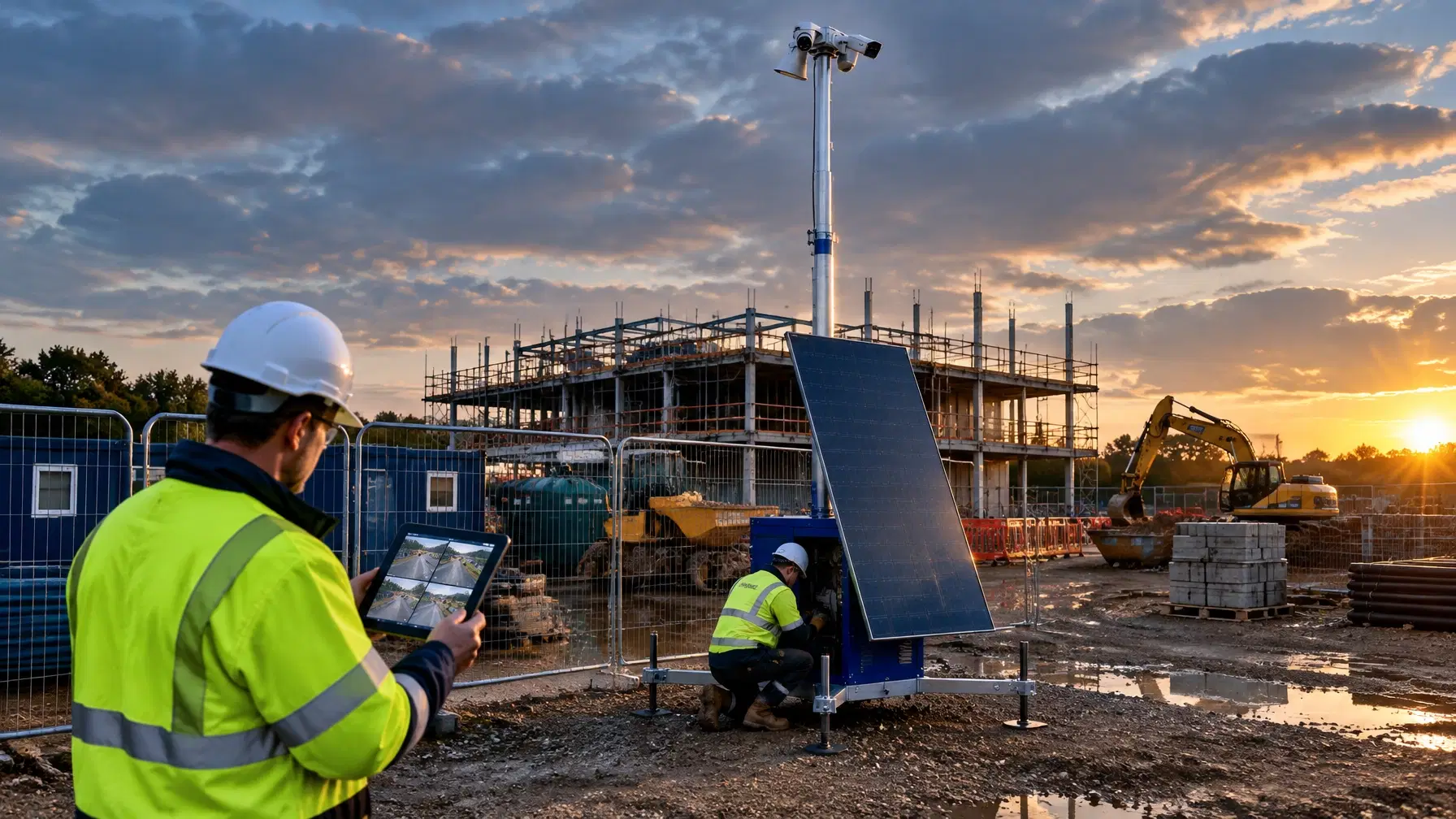
It is early autumn.
The light is fading earlier every evening. By 16:30, the plant compound is quiet. The last site vehicle has left. The shutters are down. The scaffold is still standing, the equipment is still outside and the perimeter is still exposed.
Your static alarm is armed.
But what can it actually see?
That is the question professional installers and integrators need to ask before reaching for the catalogue.
A static alarm protects the doors, rooms and assets within its detection field. It does not automatically provide a visible deterrent, elevated camera coverage or a clear view across an open compound.
That is where construction site security towers add a critical layer.
Not as a replacement for detection.
As the visible, elevated and mobile part of a multi-layered security design.
Start With the Site, Not the Catalogue
Every temporary site is different.
A tower placed beside a plant compound may need to cover vehicle access, stored materials and the rear fence line. A scaffold project may need elevated visibility over the structure and approaches. A void property may need a visible deterrent at the entrance, combined with alarm detection and controlled access.
Start with the site.
Then specify the equipment.
Wall2Wall Security towers are available for hire or purchase and are designed for rapid deployment across:
- Construction and demolition sites.
- Hire and plant compounds.
- Scaffolding projects.
- Vacant land and temporary works areas.
- Void properties and empty commercial buildings.
The requirement is growing. Industry estimates put the annual cost of UK construction site theft in the hundreds of millions of pounds, with more than 11,000 plant theft incidents reported each year and less than 15 per cent of stolen plant recovered.
The risk is not theoretical.
And the installation is only half the job.
Add the Visible Layer Your Alarm Cannot Provide
A discreet alarm may detect an opening door or movement inside a building.
A tower does more.
It announces that the site is actively protected.
The raised mast puts cameras, lighting and communications above many of the obstructions that make ground-level coverage difficult. Fencing, plant, material stacks and temporary structures are less likely to create the same blind spots.
The result is:
- 👁️ Elevated camera coverage across wider areas.
- 🚨 Visible deterrence at gates, compounds and access routes.
- 🌙 Better awareness during darker autumn and winter evenings.
- 📡 A flexible surveillance point that can move as the job changes.
- 🔋 Solar-powered operation where mains power is unavailable or unsuitable.
- 📱 Live status and event visibility through connected security systems.
A tower gives your client something an alarm panel cannot: a clear visual message that the site is watched.
That matters when opportunistic intruders are deciding which compound to approach.
Build the Layers From Outside In
The strongest temporary site security designs combine different technologies, each with a defined role.
Outer layer: Optex wireless perimeter detection
Start at the boundary.
Optex wireless perimeter detection can be used around temporary fencing, scaffold edges, gates and open approaches.
Depending on the site, this may include:
- Wireless outdoor curtain detection for narrow scaffold or frontage protection.
- Battery-powered infrared beams across longer approach routes.
- Outdoor detectors positioned to identify movement before an intruder reaches the building or plant.
This is your early-warning layer.
It helps identify an approach before the threat reaches the inner site.
Visible layer: the security tower
Position the tower where it can be seen and where its cameras have useful sightlines.
The Wall2Wall tower platform features:
- A telescopic mast extendable up to 4 metres.
- Up to four camera mounts.
- Options for lighting and audio challenge equipment.
- Solar power readiness, including 400W panel options.
- A secure, weather-resistant steel cabinet.
- Installation and operation in under an hour, subject to site conditions.
The tower moves with the job.
As the entrance changes, the compound expands or scaffolding progresses, the security design can be reconfigured rather than abandoned.
Inner layers: VESTA rapid deployment alarms
The tower should not stand alone.
VESTA rapid deployment alarms protect the buildings, welfare units, containers, plant rooms and other vulnerable inner areas.
A practical VESTA specification can include:
- VESTA 068 hub: 4G communication and support for up to 50 wireless devices, providing a flexible foundation for temporary sites.
- VESTA 460 outdoor PIRCAM: HD visual verification with infrared illumination, helping distinguish genuine intrusions from environmental triggers.
- VESTA 011 keypad: Straightforward arm and disarm control for authorised site users.
- VESTA outdoor siren: Immediate audible and visual deterrence, with suitable models delivering up to 104dB at 1 metre.
- VESTA 039 manual call point: A clearly identified emergency activation device where the site risk assessment requires one.
The VESTA system can also be managed through the SmartHomeSec app, giving authorised users event visibility, system status and remote control.
For critical projects, pair this with professional monitoring services and a defined ARC (Alarm Receiving Centre) response process.
The tower provides the eyes.
The perimeter detects the approach.
The VESTA system protects the inner zones.
That is a proper multi-layered security design.

Position the Tower Properly
A tower is only as effective as its deployment.
Before installation, confirm:
Sightlines
Avoid placing the tower directly behind stacked materials, welfare cabins or dense fencing.
Prioritise:
- Main vehicle and pedestrian entrances.
- Plant and fuel compounds.
- High-value storage areas.
- Scaffold approaches and open elevations.
- Long fence lines or vulnerable corners.
Mast height
Use the mast height to look over temporary obstructions without creating unnecessary exposure to high winds or site impact.
The highest position is not always the best position.
Lighting and IR
Specify visible lighting where deterrence is important. Confirm infrared capability and night-time image performance where the site must remain discreet or lighting levels are low.
Solar versus mains
Solar power is ideal where the site has no reliable infrastructure or where cables could be cut. Mains may be appropriate on established compounds with protected power supplies.
Always consider winter light levels, battery capacity and expected duty cycle.
Tamper and mast security
The base, cabinet, mast and camera mounts must be protected from interference.
Check:
- Cabinet access and tamper protection.
- Mast stability and anchoring.
- Protection against vehicle impact.
- Cable routing and exposed connections.
- Clear ownership of repositioning and maintenance.
When a Tower Is the Wrong Answer
A tower is not automatically the right solution for every site.
It may be the wrong answer when:
- The area is too enclosed for useful camera sightlines.
- The tower cannot be positioned safely or securely.
- The main risk is a small internal room requiring detailed access control.
- The site is too close to public areas for lighting, audio or camera privacy requirements.
- There is no suitable process for responding to verified events.
- The project needs fire, life-safety or specialist detection that a tower cannot provide.
Be honest during the survey.
A tower should add value to the design. It should not be specified simply because it is visible.
In some cases, a solar security unit, pod, VESTA alarm package or additional perimeter detection will be more appropriate.
Complete the Commissioning and Handover Properly
Before the system goes live, use a written checklist.
Commissioning checklist
- ✅ Confirm tower position, mast height and camera sightlines.
- ✅ Test day and night views, lighting and infrared performance.
- ✅ Confirm solar charging or mains supply and battery condition.
- ✅ Check cabinet, mast and equipment tamper protection.
- ✅ Test each Optex perimeter device and confirm the correct zone.
- ✅ Trigger the VESTA 460 and verify images are received.
- ✅ Test the VESTA 068 4G connection and wireless devices.
- ✅ Confirm the VESTA 011 keypad operation.
- ✅ Test the outdoor siren and agreed audible settings.
- ✅ Test the VESTA 039 manual call point where installed.
- ✅ Confirm SmartHomeSec app access for authorised users.
- ✅ Confirm professional monitoring services and ARC escalation details.
- ✅ Record keyholder contacts, access arrangements and site changes.
- ✅ Provide a clear plan showing tower, sensors, entrances and emergency routes.
Handover should include more than a password and a quick demonstration.
Explain what each layer does.
Explain what happens after an activation.
Explain who is contacted, how the site is accessed and when the tower should be moved.
For more on response planning, read our guide to designing an ARC response for temporary site security.
Move With the Job
Scaffolding rises.
Fencing moves.
Plant compounds expand.
Void properties change hands.
Your security design needs to keep up.

That is why the next generation of scaffolding security systems, void property alarm systems, battery powered alarm systems and wireless site alarms must be flexible from day one.
Read our guides on scaffolding security systems and void property alarm systems for more specification insight.
With more than 30 years of industry experience, Wall2Wall Security helps installers and integrators build practical, rapid deployment security solutions around real site conditions.
If you are specifying a tower for hire or purchase, or designing a wider perimeter security package, contact Wall2Wall Security.
Where would an elevated, visible security layer make the biggest difference on your next site: the gate, the plant compound or the scaffold line?
Meta description: Discover how construction site security towers add visible deterrence and elevated camera coverage to multi-layered temporary site security, alongside Optex and VESTA.