








Meta description: Visual verification helps installers turn temporary-site alarms into informed action. See how the VESTA 460 PIRCAM sends images to the ARC.
It’s 3.12am. A phone rings. An outdoor detector has activated at a site you installed last week.
Is it an intruder? A fox? Wind moving something loose against the fence?
Without an image, someone has to make a decision with only a signal and a site address. That uncertainty is the weak link in too many temporary security systems.
Visual verification changes the question from “What might have happened?” to “What can we see?”
This post covers the install side of that change: where the detector goes, what its camera can and cannot see at night, how the images reach the ARC, and what an operator does with a picture rather than a bare signal.
Stop treating every activation as the same alarm
An outdoor detector can be doing its job perfectly and still report movement that is not a threat. Weather, wildlife, foliage and unsecured litter can all create activity around a site.
Each unverified activation can mean keyholder calls and unnecessary attendance. A stream of nuisance alarms also creates alarm fatigue: when every alert sounds equally urgent, a genuine incident is harder to spot. And a bare signal gives an operator limited grounds to judge what is happening. Verification can help inform escalation; it does not guarantee a particular police response.
For your client, the cost is not just one wasted call-out. It is confidence in the security system.
Put the picture beside the detection
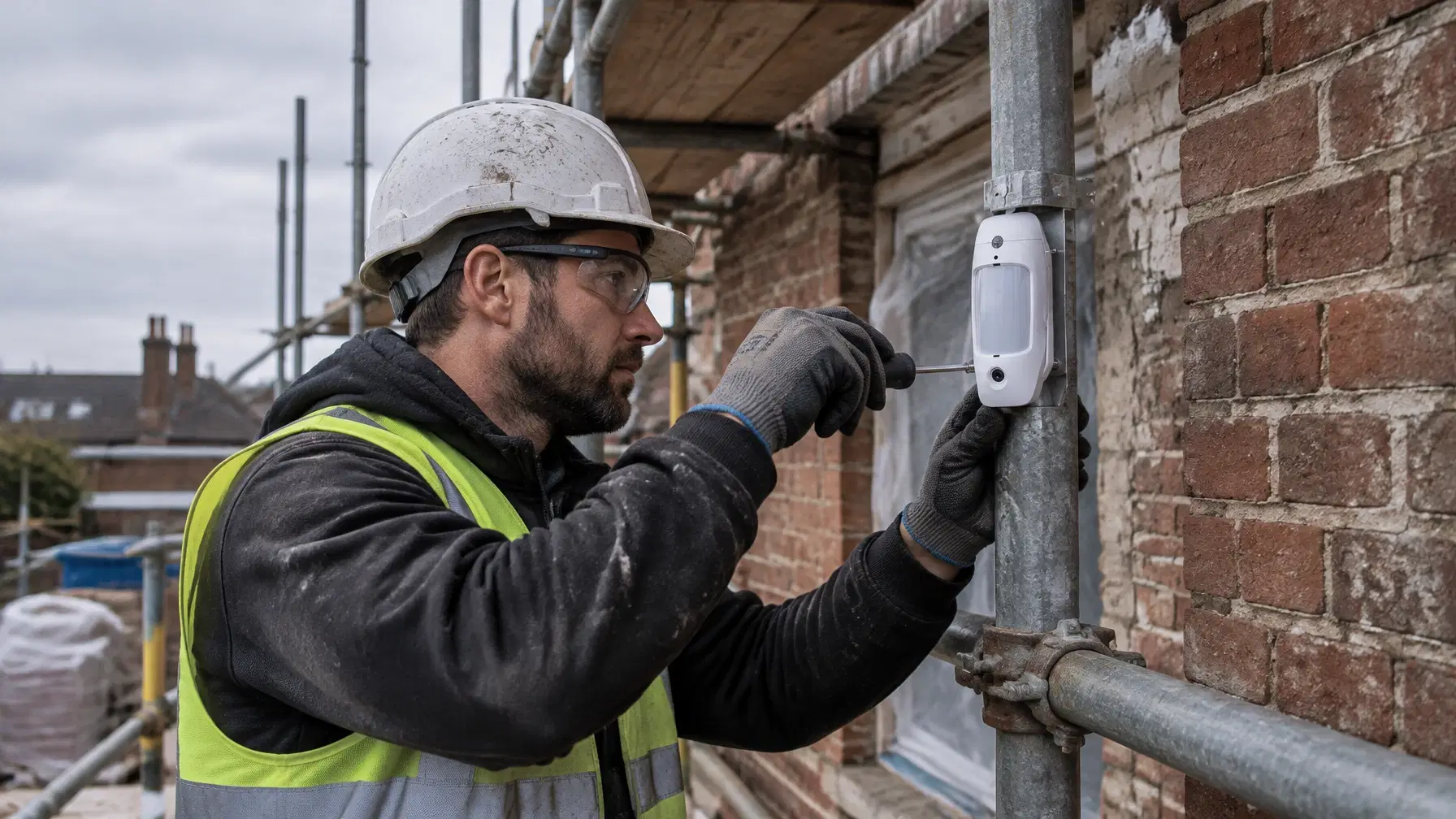
The VESTA 460 outdoor PIRCAM combines a PIR detector and camera in one outdoor unit. When it activates, it captures images and sends them to the ARC for visual verification.
The operator can assess what appears to have triggered the alarm: an intruder, wildlife, weather movement, foliage or litter. That context gives the alarm a meaning that a bare activation cannot provide.

It is built for exposed sites: 10m PIR coverage over 90°, infrared illumination up to 10m, 1280 × 720 images, IP65 rating and anti-masking.
Explore the VESTA range for product and system details.
Getting the image to the ARC
How the images travel matters as much as the detector itself. The VESTA 460 works with the VESTA 068 hub, which sends captured images over 4G to the ARC (Alarm Receiving Centre) alongside the alarm signal. No fixed broadband, no site internet, no cabling run: which is what makes it work on a compound, scaffold or empty building with neither power nor Wi-Fi.
Two commissioning checks: signal strength at the hub (a weak 4G connection delays or drops images, and an image that arrives after the decision is worth little) and image delivery settings (how many images per activation, how quickly they reach the operator, then test the full path from trigger to screen before handover).
What the operator does with an image
The benefit is straightforward: the alarm is no longer just an alert to investigate. It arrives with visual context.
With a bare signal, the operator works from a zone name and a sequence of activations. With an image, they can see whether the movement is a person, a vehicle or a branch, and whether anyone in the frame is carrying anything. That is the difference between escalating on hope and escalating on evidence.
Professional monitoring services use that context to separate non-threat activity from a potential intrusion, and images give your client a clearer account of what happened instead of a timestamp and a zone name.
One caveat worth stating honestly: verification informs the escalation decision. It does not guarantee a particular police response, which depends on force policy and the circumstances of the event. What it changes is the quality of the information the operator works with, and the confidence your client has in the system.
A few placement rules carry most of the weight:
- Cover the approach, not the whole site. The PIRCAM earns its keep watching gates, scaffold ladder access, compound entrances and the route to high-value plant, where an image can settle the question of who or what is there.
- Mind the mounting height. Too high reads heads and hats; too low fills the frame with ground clutter. Around 2.5 metres, angled down across the approach, suits a 10m / 90° field.
- Respect the IR range. Infrared illumination reaches about 10 metres; beyond that, night images darken into guesswork. Keep the unit within range of the approach it protects, away from its own detection zone and reflective surfaces.
- Watch the background. Approaches facing low winter sun, site lighting or a busy road generate nuisance activations that cost your client money in unnecessary attendance.
- Plan for the site in three months. Access routes and stored materials move, so specify units where an image will still be useful once the site has changed.
The VESTA 460 works as part of multi-layered security, not as a replacement for perimeter detection. Optex wireless perimeter detection creates the outer layer: the BXS-R (W) gives narrow outdoor detection, the AX-200TFR is a battery-operated infrared beam with a 60m outdoor range. Where PIRCAM coverage adds useful context at key approaches depends on the configuration.

See the Optex perimeter detection range.
Make it work where the site is changing
Temporary sites often need protection before permanent power or communications exist. The VESTA 068 hub provides 4G communication, supports up to 50 wireless devices and runs as part of a battery-powered wireless alarm system, so cabling does not slow deployment or become redundant as the project changes. That is rapid deployment security earning its name.
For void property alarm systems it is equally valuable: a vacant property may have nobody nearby to check an activation, and false call-outs add cost without improving protection. The insurer’s requirements come first; our void property guide is the place to start, and our scaffolding security guide covers changing access points on scaffolded projects.
An alarm tells you something happened; an image tells you what it was
The point is not another device on a specification. It is a more useful activation.
With the VESTA 460, a PIR trigger arrives with images for the ARC to assess: less uncertainty, fewer wasted call-outs, better-informed escalation when the images show a genuine concern. Keep the ARC response design brief after that: agree how site information and verified events are handled, then document it. See What Happens After the Alarm Sounds? for the wider process.

We have spent more than 30 years working with installers and integrators on rapid deployment security for temporary and changing sites. Seeing what triggered an alarm is one of the simplest ways to make detection actionable.
If you’re planning a site with outdoor detection, ask yourself: when the alarm goes off, will the ARC know what happened, or only that something moved?
Because an alarm tells you something happened. An image tells you what it was.
Talk to Wall2Wall Security about a VESTA 460 and wireless perimeter detection layout for your next project.