








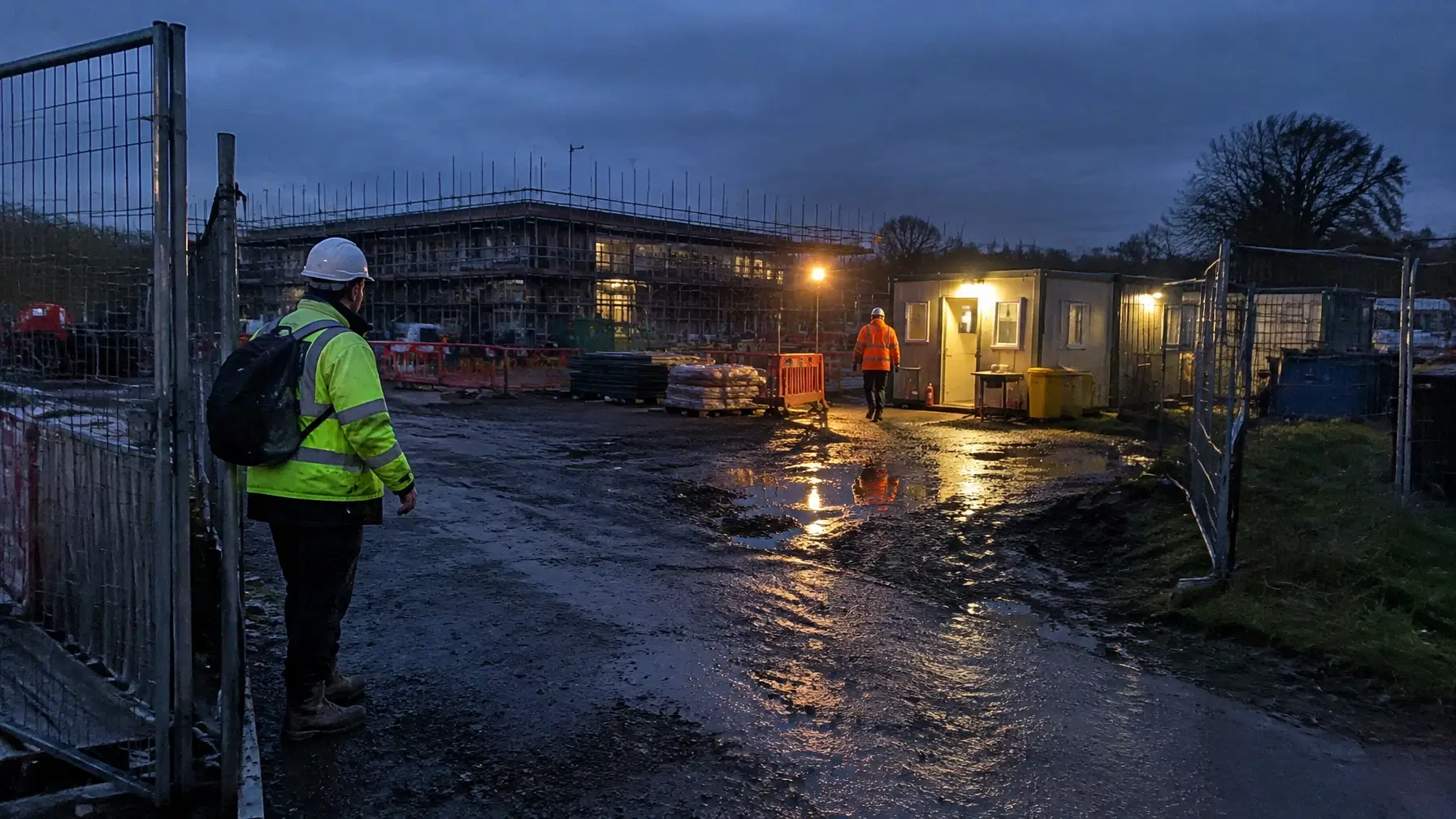
It’s 16:45 on a damp evening in late October. An installer pulls into a compound he surveyed in August, when the evenings were long and the access roads easy to see. Now the work area is lit, the far fence line is dark, and the last staff are heading out.
The site hasn’t changed. The light has.
The clocks went back on Sunday 25 October. This week, the early darkness is already part of the job. Here’s what I’d review on a temporary site: lighting, detection and response. All three work with the kit that’s already on the fence, which is the whole point of rapid deployment security when the site keeps changing around you.
1. Make lighting useful, not just brighter
Most sites keep whatever lighting was planned in summer. That can leave gates, perimeter routes and stored plant in shadow once the working day ends.
Walk the site in the dark, not just at lunchtime. Check:
- Does existing lighting still illuminate the areas you need to protect?
- Have lights been switched off, timed out or blocked by new materials or scaffold?
- Can a responder see where they’re going when they arrive?
Floodlighting everything is not the answer. Poorly aimed lights dazzle staff and responders, and wash out a camera’s view. Making a site visible is not the same as making it safe. Lighting should help people move, support useful images and avoid hiding an approach in glare.

2. Test detection in the conditions it now faces
Walk the detection field, not last month’s drawing
Longer nights mean more of the unattended period falls in darkness. That is not a reason to turn up sensitivity and hope. It means checking detection still fits the site as it is now.
Seasonal nuisance alarms come from low sun, wildlife, moving vegetation, wet surfaces and changing thermal contrast after dark. Detection is the part of perimeter security that tells you something is happening while it is happening. So walk the wireless perimeter detection field. Has vegetation grown into it? Have stacked materials or moved fencing created an obstruction? Are detectors still aimed at the routes people would use today?
Check night-time images rather than assuming infrared performance will be good enough. A detector may register movement, but poor positioning or glare can leave the ARC with little useful context.
Optex options suit different perimeters: BXS-R (W) curtain detection, battery-powered AX-200TFR beams with a 60-metre outdoor range, and Redscan LiDAR for the right layouts. Each needs specifying, aligning and testing for the site in front of you, not the site on last month’s drawing. See the Optex range.
Cold also matters to battery powered alarm systems. Lithium and alkaline cells lose usable capacity as temperatures fall. Check battery health and device status before winter, then set a sensible maintenance plan. A low-battery warning in January is a poor substitute for a check this week.
For inner layers, the VESTA 068 provides 4G communication and supports up to 50 wireless devices. The outdoor VESTA 460 PIRCAM gives HD images, a 10-metre / 90-degree PIR field, IP65 protection and infrared illumination, which is what you want for night-time verification. Test the image at night, not during commissioning in daylight. The VESTA range also includes the VESTA 011 keypad and an outdoor siren rated up to 104dB at 1 metre.

3. Revisit the response before the first 03:00 call
The ARC is only as good as the details it holds
Response is the layer nobody revisits. But site use changes. People leave. Contractors change. A gate that was open in the day may be locked after hours.
Ask whether the ARC (Alarm Receiving Centre) has current site and keyholder details. Does the escalation process match how the site is used now? Who actually turns out in the dark on a Sunday night? And can they get in once they arrive?
That last one catches people out. If the only keyholder has come off the job, a Loxal key safe with temporary and permanent codes gets a responder onto site without copying a key or handing over an alarm code.
An unverified alarm at 03:00 in December is a different job to the same alarm in June: no staff on site, little light and poor visibility for whoever responds. Agree the verification, access and escalation in advance. Review the ARC response guide, and make sure authorised users know how to use the SmartHomeSec app.

The fire layer does not take the winter off
One thing that does not change with the season is the fire side of PAS 9970.
On an occupied site a manual call point belongs where people are: at final exits and on escape routes, reachable and signed. That is the Vesta 039, and it is not a smoke detector. Treating the two as interchangeable causes problems at handover. With nobody on site overnight, a call point only works once somebody is there to press it, so the automatic layer takes the dark shift: smoke and heat detection specified from the risk assessment.
- 🚨 Vesta 039 manual call point at exits, signed and reachable.
- 🔥 Automatic smoke detection for the unattended hours.
- 🔔 Both reporting through the VESTA hub and out to the ARC.
Industry reporting estimates that construction site theft costs the UK over £1 billion a year, with more than 11,000 plant thefts annually and under 15% recovered. Worth a thought while the site is still easy to walk in daylight.
Walk the site with this winter checklist
- ✅ Check lighting at gates, fence lines, plant and storage areas after dark.
- ✅ Clear vegetation and obstructions from perimeter detection fields.
- ✅ Confirm detectors still cover current access routes and site boundaries.
- ✅ Test infrared images at night and check the view from the ARC.
- ✅ Check battery condition, low-battery alerts, supervision and 4G.
- ✅ Confirm ARC contacts, keyholder details and escalation instructions are current.
- ✅ Confirm out-of-hours responders can actually access the site.
Fix the biggest gap first
If time or budget is tight, start with the failure that would leave the site exposed: a blind access point, an obstructed detector, a dead battery or an out-of-date response contact. Multi-layered security is not about adding more boxes to a wall. It is Optex watching the boundary, VESTA protecting the inner zones and an ARC ready to act, and it is worth reviewing the same way on void property alarm systems, where there is nobody on site at all. Then test the alarm path end to end.
Not every site needs more kit. Often the right fix is repositioning, cleaning, re-aiming or re-timing what is already installed. If the scaffold is still climbing, our scaffolding security guide covers moving the same kit as lifts are added. And where an elevated visible layer makes sense through the darker months, construction site security towers are a practical option. Specify to the site, not the season alone.
We’ve spent 30+ years helping installers and integrators secure temporary and changing environments. If you’re reviewing a site this week, get in touch and we’ll help you work through the options.
What’s the first thing you check when you revisit a site after the clocks change?
Meta description: A winter checklist for temporary site security: lighting, wireless perimeter detection, batteries, PAS 9970 fire cover and ARC response.